

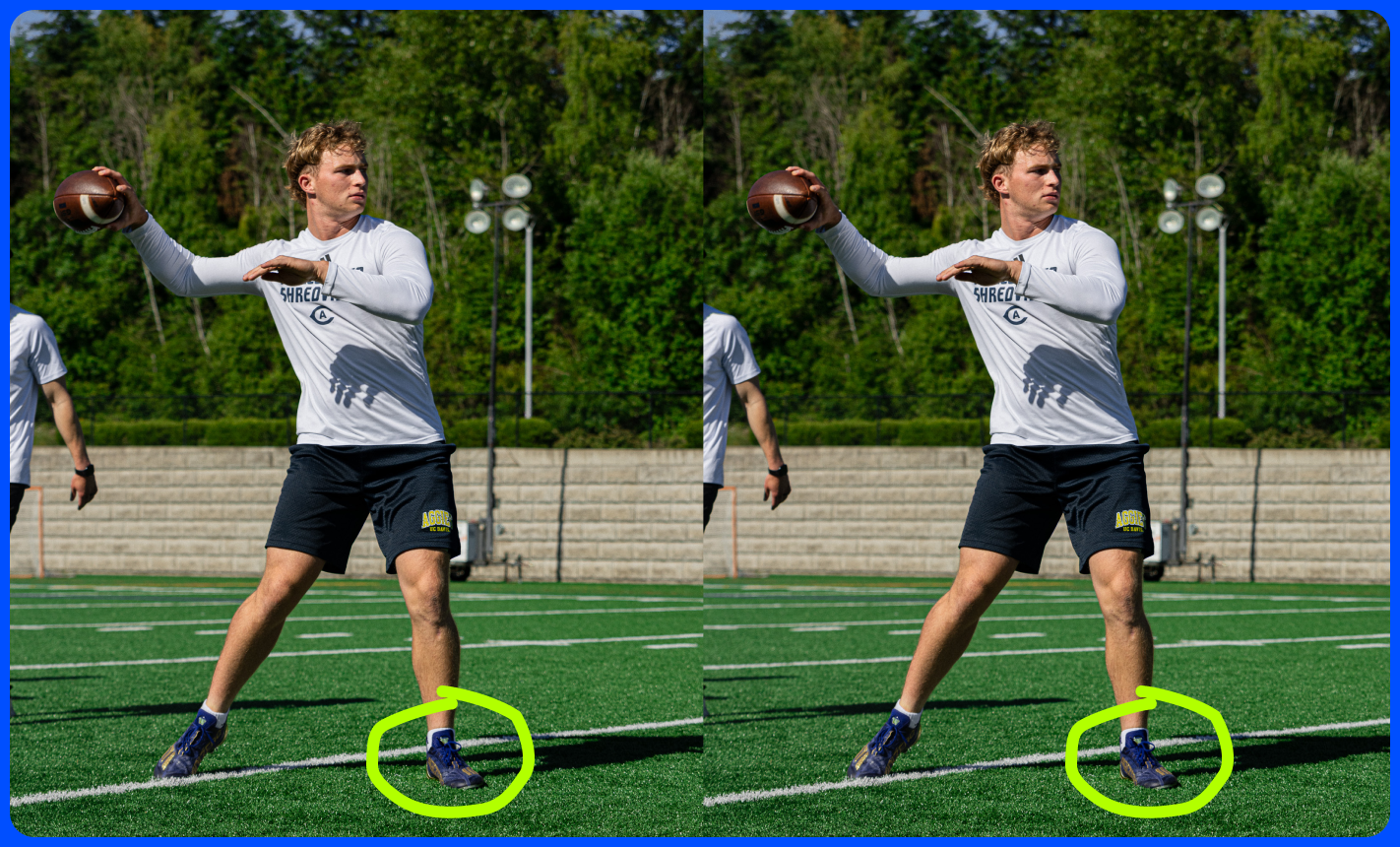
Many breakdowns with accuracy and velocity can be linked back to the quarterback’s base and stride step.
The throwing motion is a kinetic chain. Force is generated at the ground, transferred up through the legs and hips, redirected through the torso, and finally expressed out through the arm and into the football. Like any kinetic chain (golf swing, pitcher's delivery, a boxer's punch) the sequence only works if each link fires in order and on time. The stride step is the first link. Everything downstream of it is constrained by what happens at that moment the front foot meets the ground.
This is why I tell every quarterback I work with the same thing: you cannot out-arm a bad stride. A strong arm built on top of a poor stride step will produce flashes of good throws and long stretches of inconsistency with accuracy and velocity. Fix the stride, and it becomes so much easier to fix everything else downstream.
Below are four non-negotiables I coach into every quarterback's stride step, and the mechanical reasoning behind each one.
One of the biggest stride-step errors I see, at every level, including college and pro, is a stride that takes too long to land.
Here's why that matters: the hips cannot begin rotating until the front foot is planted and the kinetic chain has a stable base to rotate against. Hip rotation against an unplanted, "floating" front leg has nothing to push against… there's no ground reaction force to convert into rotational energy. So if the stride is long and slow, the entire sequence stalls. The QB ends up rotating the hips late, rushing to compensate, or rotating before the foot is even down, which disconnects the lower half from the upper half entirely.
The cue I use is simple: the throw starts with the stride… try to delay the hands until the stride occurs. Think of the stride as a sprinter's first step out of the blocks, not a controlled, gliding lunge. A quick stride does two things simultaneously: it shortens the window between "load" and "fire," and it lets the hips start rotating earlier in the sequence, which gives the rest of the chain more time and more ground to accelerate through before the ball leaves the hand.
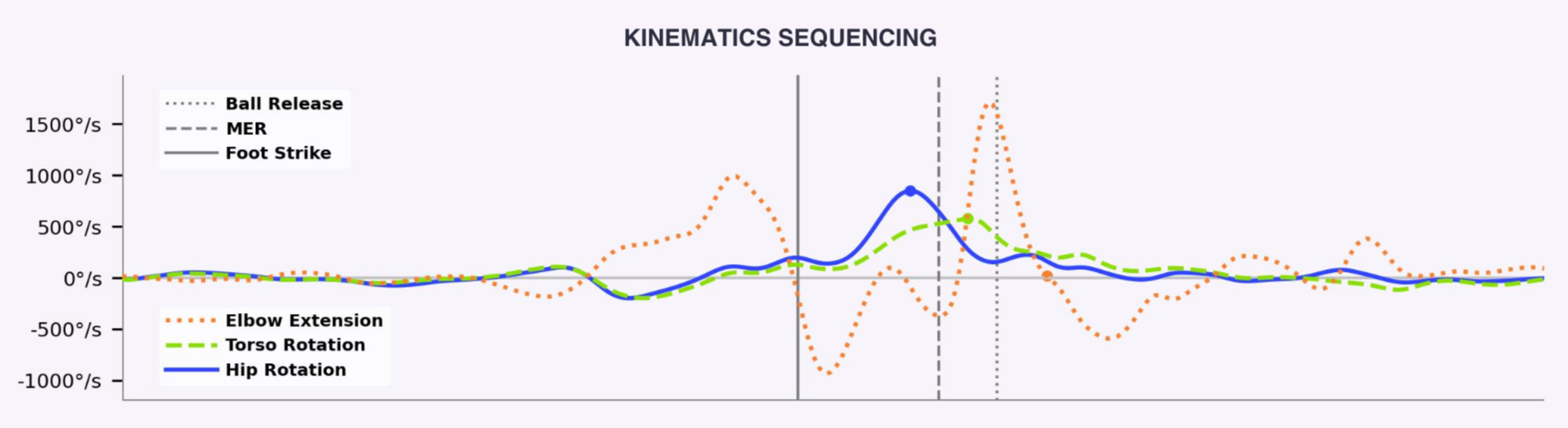
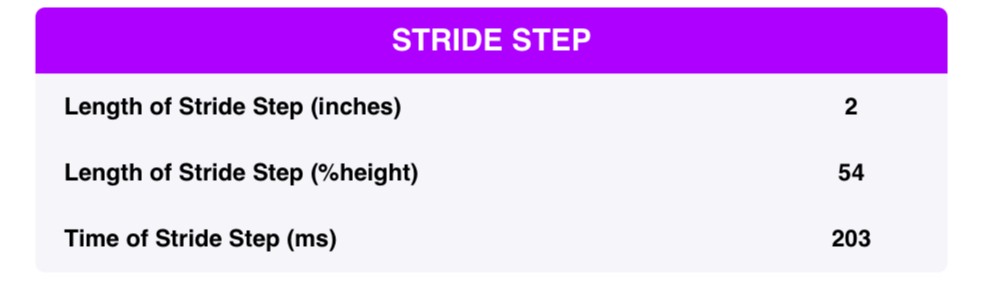
I like to trend timing and magnitude of hip velocity relative to stride step (“foot strike”) to see how efficient the QB was with the timing of their stride step.
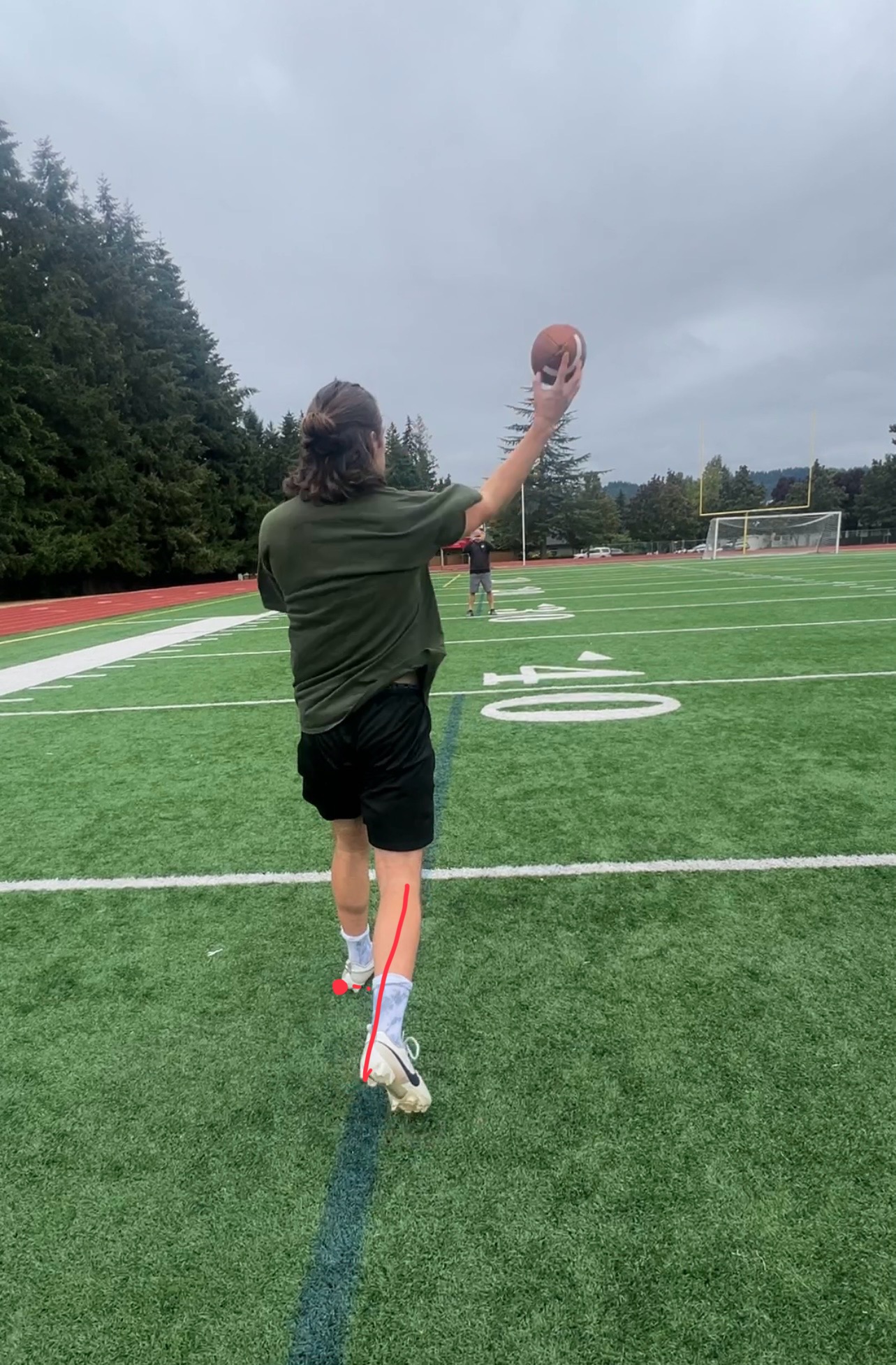
"Midline" refers to the line running directly between the heels at the start of the throwing motion; essentially the QB's centerline relative to the target. Where the front foot lands relative to that line determines how freely the hips can rotate.
Step directly on midline, or worse, across it, and the front hip gets mechanically blocked. The pelvis can't rotate efficiently because the front leg is now positioned in a way that closes off hip mobility rather than opening a lane for rotation. You'll see QBs compensate for this by spinning the upper body independently of the lower half, which disconnects the chain and forces the arm to do work that the hips and trunk should be doing. QBs that do this will also often pull their head or upper body to the side since the lower ½ cannot rotate efficiently.
The fix is a stride that lands slightly off midline (about 3-4 inches) which opens enough to give the hip a clear, unobstructed path to rotate through. But this is a spectrum with failure points on both ends. Stride too far off midline in the other direction, and you create a different problem: energy starts leaking out of the system laterally instead of rotating toward the target. The center of mass gets pulled to the side (left, for a right-handed thrower), trunk lean becomes excessive, and force that should be transferring forward into the throw instead dissipates sideways. Accuracy suffers because the body is fighting its own momentum instead of channeling it.
The target is a narrow window… open enough to free the hip, but tight enough to keep the center of mass tracking toward the target. This is one of the most individualized parts of the stride step; the exact distance varies slightly by hip mobility and build, but the principle (slightly off midline, never on or across it, never excessive) holds across every QB I've coached.
Foot angle at landing gets overlooked constantly, but it functions as the braking system for the entire kinetic chain.
If the lead foot lands with toes pointed fully open (90 degrees) at the target, there's no mechanism left to stop or redirect the forward momentum of the stride. Force keeps traveling straight through the front leg and out past the target line instead of being captured and redirected rotationally. The front side has nothing to brace against, so instead of the energy being transferred up and into the throw, it leaks out past the target. This often shows up as throws that pull to the side or sail, or feel "leaky" even when the arm action looks fine.
A slightly closed front foot, somewhere in the range of 60 to 70 degrees relative to the target, creates a good braking system. It gives the front leg something to brace against as the hips and trunk rotate into it, which is what allows that rotational energy to actually transfer upward into the throw instead of bleeding out through the front side. Think of it as the difference between hitting a wall and hitting an open door: a slightly closed foot is the wall the rest of the chain rotates against. A fully open foot is the open door that all the energy just runs through and out.
This is a small detail, but it has an outsized effect on how efficiently force makes it from the ground into the ball.
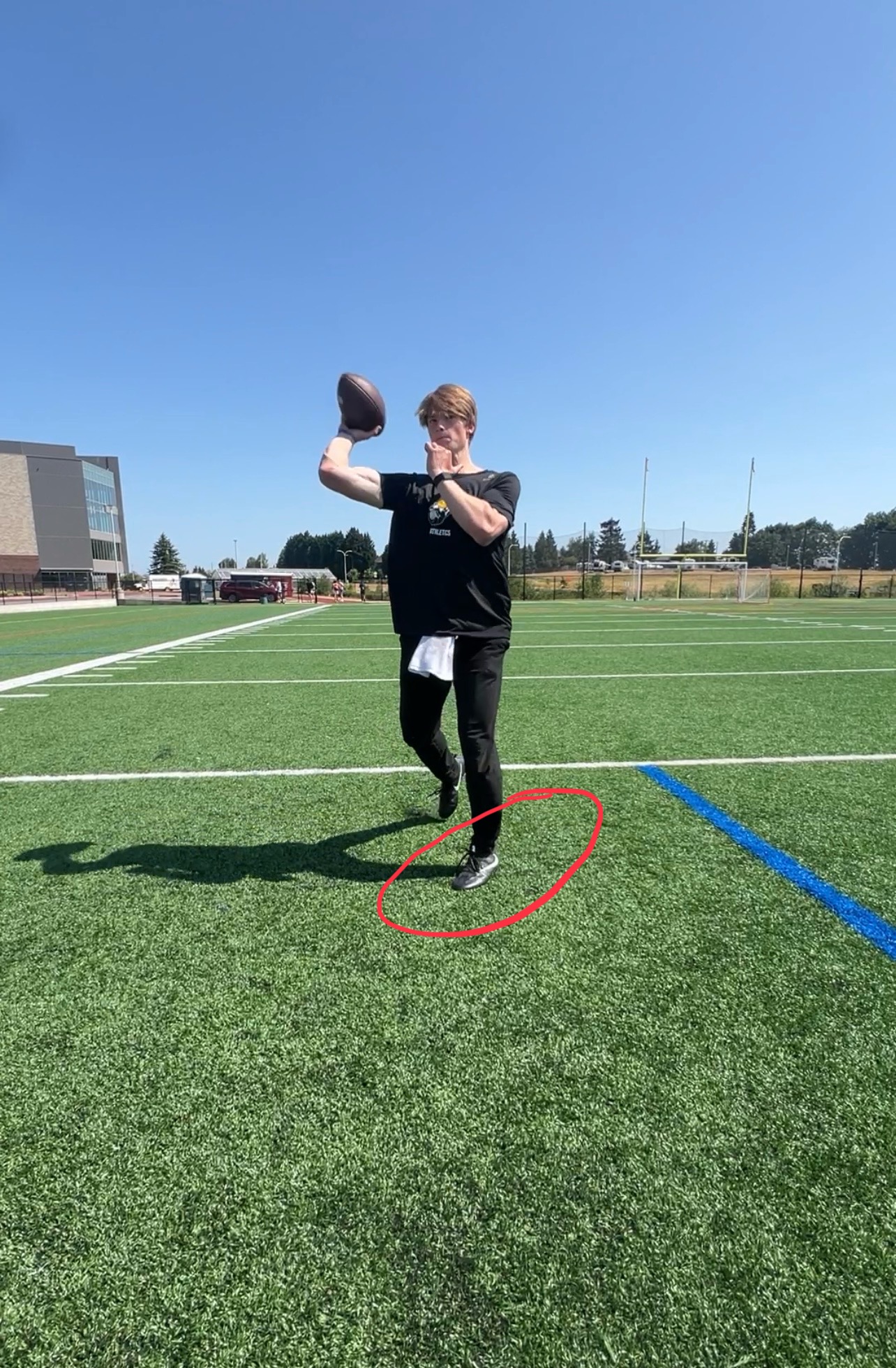
The last non-negotiable happens after landing. Once the front foot is down, it needs to become a stable, braced post for the body to rotate around.
A lot of young quarterbacks land the front foot and then let it rotate or "spin out" as the hips turn through the throw. This feels natural because it mimics the direction of rotation, but it's mechanically costly. When the front foot spins with the body instead of staying planted, the base loses rigidity at the exact moment it needs to be firmest. Instead of the leg acting as a fixed axis that the rest of the body rotates around, the leg becomes part of the rotation itself, and energy that should be transferring up the chain gets absorbed and lost in that foot movement.
The cue here is "land and brace." The front foot plants, takes the load, and stays stable while the hips, trunk, and shoulders rotate over and around it. The front side has to brace for rotational force to transfer efficiently into the next segment of the chain.
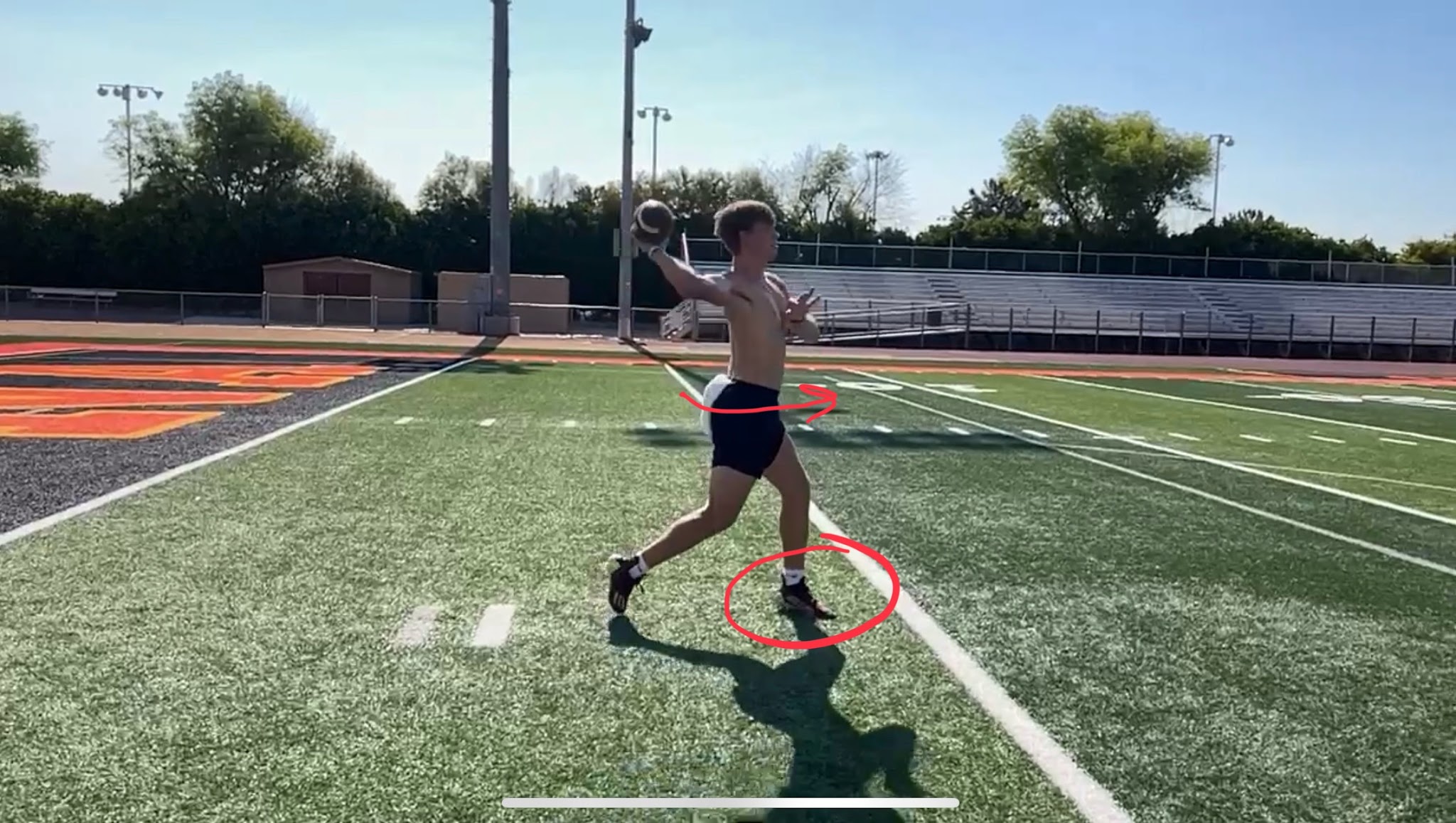
I see tons of quarterbacks at all levels whose accuracy or velocity issues trace back, at least partially, to the base and stride step. It's an unglamorous part of the throwing motion, but it's the part of the sequence that determines whether everything downstream even has a chance to work correctly.
A QB can have an elite arm and still throw inconsistently if the stride is inconsistent, because the stride dictates timing, hip access, energy transfer, and stability. Fix the stride, and the rest of the chain has a stable, repeatable foundation to build on. That's why it's the first thing I evaluate with every quarterback I work with, and why it remains non-negotiable regardless of age, level, or arm strength: you can't build a repeatable and efficient throwing motion on top of an inconsistent base.